You are pointing the right way. You are still not getting there.
You know what would make the difference. Perhaps you set it out properly at some point, and it was clear at the time. Then urgency arrived, new things crowded out the things that mattered, and you were busy the entire time. When you look back, the moves that would actually have changed something are roughly where they were.
That is not a lack of effort. It is almost never a lack of ideas.
It is drift, and drift is a technical term. In flying, drift is the difference between where an aircraft is pointing and where it ends up. Wind causes it. It is always present, and it cannot be seen directly from inside the cockpit.
An aircraft in drift is flying perfectly. The engine is fine. The heading is exactly what the pilot set. Yet it is arriving somewhere it did not intend, because nothing corrects for drift unless somebody notices it and consciously corrects for it.
The same is true of a business. Almost nothing in an ordinary one is designed to allow for it.
This page sets out how we think about that: what is actually going wrong, the three things that hold a business on course, and how far down you may want to go. It takes about ten minutes to read.
What is actually wrong
What a founder brings us tends not to be what is really wrong. It tends to be the symptom: the part that is visible from where you are standing, and the part that is easiest to say.
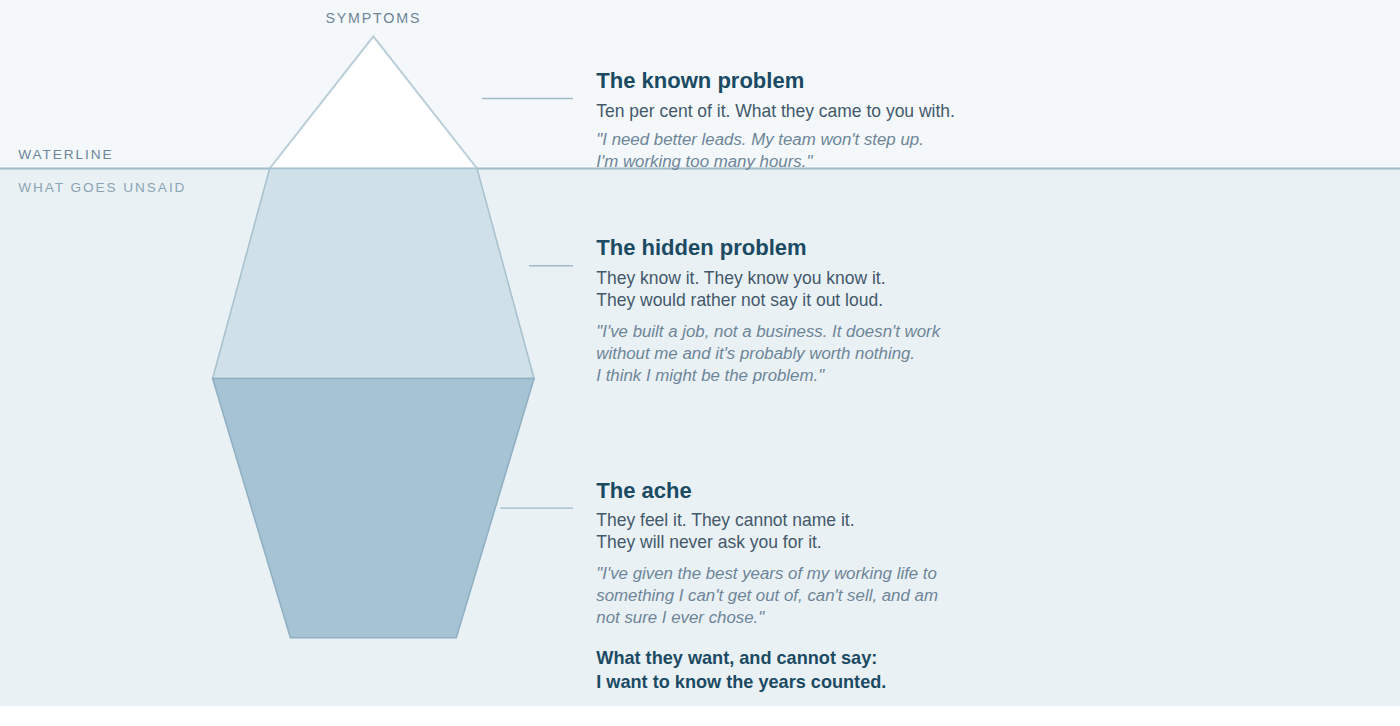
The known problem. What you would say if we asked today. "I need better leads. My team won't step up. I'm working too many hours."
The hidden problem. You know it. You would rather not say it. "I've built a job, not a business. It doesn't work without me and it's probably worth nothing. I think I might be the problem."
The ache. Felt, rarely named, never asked for. "I've given the best years of my working life to something I can't get out of, can't sell, and am not sure I ever chose." What you want, and would never put in an email: to know the years counted.
And here is the part almost nobody says out loud. The hidden problem is not that you are not good enough. It is the opposite.
You are not stopped by what you are bad at. You are stopped by what you are best at.
The capability that built your business is precisely the capability that stops it running without you. Which is why you cannot be argued out of it, and why advice bounces off. Every time you take something back and do it yourself, you are right. It is quicker. It is better. The client is happier. The trap is load-bearing, and the evidence is on your side.
So this is not about trying harder or caring more. You have already tried that, and it worked in the moment, and that is the problem.
BizSmart Scaleup Challenges research, 2021. Scalable was defined strictly: at least a quarter of sales recurring, low reliance on the owner, able to handle five times the volume, and a real competitive advantage. Seven per cent passed all four.
Three things hold a business on course
Take any one away and the shape collapses. Each collapse has its own name, which matters more than it sounds, because most founders call all three the same thing.
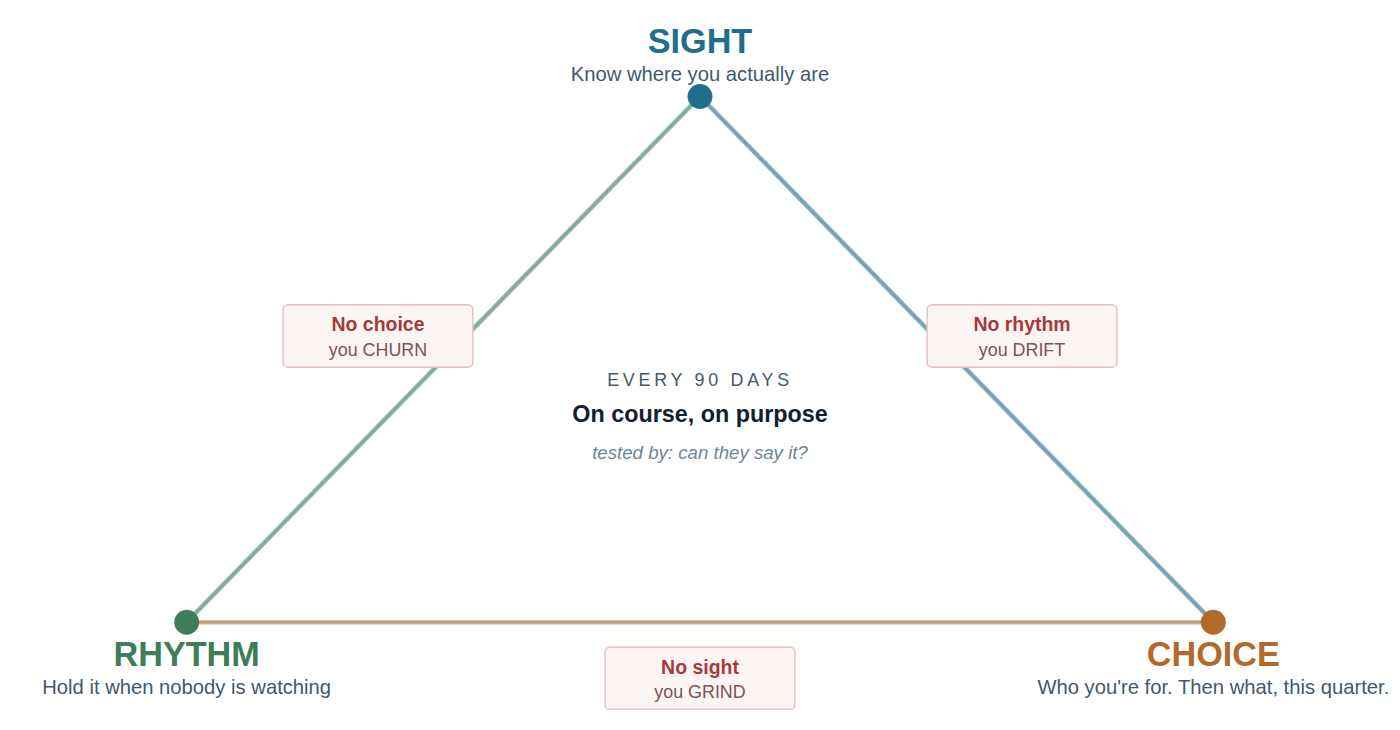
Sight. Know where you actually are.
Choice. Who you're for. Then what, this quarter.
Rhythm. Hold it when nobody is watching.
| Missing | Failure | What it feels like from the inside | What it actually needs |
|---|---|---|---|
| Rhythm | Drift | You worked it out properly once. You knew exactly what mattered. Some weeks later it had gone, and you could not say when. | A cadence. Not another plan. |
| Sight | Grind | Disciplined, consistent, working extremely hard, and on the wrong thing. Or building for the next stage while standing in a dip you have not noticed you are in. | An honest score, and someone outside the business who will say what they see. |
| Choice | Churn | You can see everything that needs doing, and you are doing all of it. Nineteen priorities. Everything started, nothing landed. | A forced trade-off. Or, more often than people expect, narrowing. |
Naming which one you are in is most of the work. It is also why the last two or three things you tried did not stick. A founder who is grinding does not need a better planning system. A founder who is churning does not need more accountability. Prescribing rhythm to a sight problem is the commonest wasted year in business.
If you are not sure which one you are in, the quickest test is to ask what happened to the last three things you decided were important. If you cannot remember deciding, that is sight. If you remember deciding all nineteen, that is choice. If you remember deciding the right three and they quietly stopped, that is rhythm.
Choice happens at two altitudes
Who you are for. High level, reset infrequently, and the one most businesses are not really clear on, even if they think they are. Who you serve, and who you will turn away. What is your real niche?
What, this quarter. Lower level, adjusted frequently. Three to five things. Owned, measurable, and committed to out loud in front of people who will remind and check.
And you cannot do the second one well until you have done the first. If you have not decided who you are for, you will produce nineteen defensible priorities every quarter. They will not be wrong, because when you serve everybody, everything genuinely could matter. That long list is not weak operational discipline. It is your positioning showing through.
How far down do you want to go?
The same three disciplines work at any depth. The depth you take them to decides what you actually end up with, and it is your call rather than ours.
| Depth | What becomes visible | What you then have to decide | What you are left holding |
|---|---|---|---|
| The known problem | Which of drift, grind or churn you are actually in. | Three to five things this quarter, instead of nineteen. | A better-run business, quite quickly. Real, and worth having. Most of the market stops here. |
| The hidden problem | That you are the ceiling, and that what makes you the ceiling is the thing you are best at. | Narrowing. Turning work away. Handing over the things you are good at, not just the things you dislike. | A business that runs without you and is worth something to somebody else. Roughly seven in a hundred get here. |
| The ache | That nobody ever decided what this was for, or how big it needed to be, or when it stops. | The size, the shape and the ending. On purpose, rather than by default. | A business you chose, worth something without you in it, and years that counted. |
We can stay shallow and talk about leads and getting the team to step up. That is a real conversation and it produces real results. Or we can go further down. It is your choice, and there is no right answer: some of the most content owners we have interviewed built to a deliberate size and stopped, having looked clearly at what growing further would cost. That is a success, not a failure of nerve.
What we will not do is let it be decided by accident.
The tragedy is never smallness, and it is never bigness. The tragedy is only ever the life that got chosen by accident, by somebody too busy to notice they were choosing.
Two gates
Most businesses stop at one of two gates. The earlier one is where most of the businesses we work with arrive, and it is the better place to be standing, because it is where you get ahead of the next.
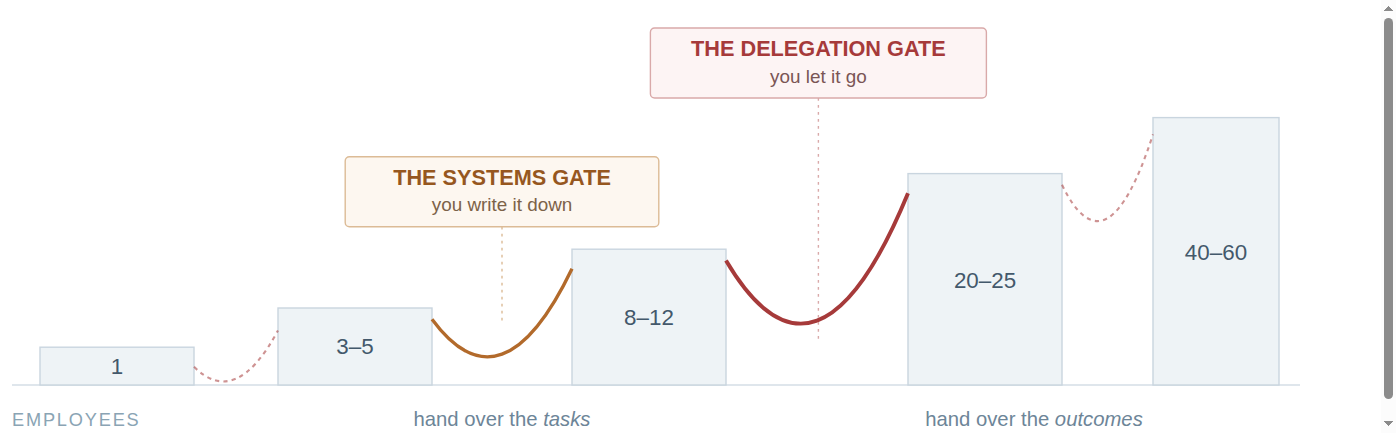
Growth is not a line. It is a series of ladders with a dip between each one, and each dip is an investment period rather than a sign something has gone wrong. Founders who know a dip is coming plan for it; founders who do not read it as failure and retreat. Inside every dip there is a gate: the thing you have to start doing differently to get out of the other side.
Two of those gates decide most of what happens, and they ask for different things. At roughly five to twelve people the business stops fitting inside your head. You start writing things down and putting in the first real processes, and you begin handing out tasks. That is genuine progress and only half the move, because everyone still comes to you: you handed over the task and kept the outcome. It is usually where a second in command starts to appear, the XO, often without the authority to be one yet.
At twelve and above, that stops working. What the business needs now is not more tasks handed out but whole outcomes handed over, including the ones you are good at. A different act, not a bigger version of the same one, and the single clearest divide across 305 founder interviews.
The first gate is where the second one is won or lost. Almost everybody pushes through the first on effort, and effort works, which is the root of the problem: you conclude that you need more process and more compliance with it. But process alone does not change where things come back to. The founders who pass the second gate well used the first properly: they wrote down what good looks like rather than only what to do, gave the XO real decisions rather than jobs, and reviewed the handover instead of hoping. Do that and the second gate is just a harder version of something you already practise. Arrive without it and it becomes a wall.
And you do not have to wait for the second gate to arrive. Nothing stops you handing over outcomes at the systems gate, while the stakes are smaller and there is less to unpick. Do it there and you reach the second gate having already practised the harder act.
You also get something worth having on its own terms: a business that works without you at the size you have already chosen, whether or not you pass the next milestone. Handing over outcomes is not a growth tactic. It is what makes the business yours rather than the other way round.
Where are you standing?
The systems gate, roughly five to twelve people. Where you have got to: you have documented how things are done, put in the first processes, and started handing work out. The tell: it still comes back to you, including from the people you hired to take it off you, and your time now goes on chasing the process. What it is asking for: hand over an outcome, not another task. Give the emerging number two a decision, not a job.
The delegation gate, roughly twelve to twenty-five. Where you have got to: you have a team that works, and much of the day to day has gone. The tell: it stops at you for anything that really matters, and you are probably still the one bringing in the business. What it is asking for: a real number two with real authority, and the outcomes you are best at handed over, not just the ones you dislike.
What this is built on
13 years running this quarterly discipline.
Thirteen years of hands-on work with owner-managed businesses, and four years of ScaleUp Radio, where more than three hundred founders talked for long enough to get past the polished version of events. Not what should have happened. What did.
Endorsed by the ScaleUp Institute. The method is set out in full in The Entrepreneurial ScaleUp System.
And what the evidence cannot tell you. Every founder in that archive was still in business when we recorded them. Survivorship bias is total. There are no post-mortems in three hundred interviews, because nobody narrates a closure from the inside. We say so because a finding is only worth what it admits it cannot support.
What we did not invent
The four pillars of scaling come from Verne Harnish. Cohesive teams from Patrick Lencioni. Profit First from Mike Michalowicz. Building for value owes a great deal to John Warrillow, and to a career spent doing the same work for much larger companies. We credit them because it is true, and because anybody claiming to have invented all of it is telling you something about themselves.
What is ours is the ScaleUp Journey and the dips between the ladders, the InFlight Checks, and the way the whole thing is put together and held. The parts are not the point. The integration is.
If any of this landed
There are two sensible next steps and neither of them costs you anything.
Find out where you actually are. The InFlight Checks score your business across sixty specific things in about twenty minutes and give you a number and a short list. Most owners find one or two items surface that they already half knew. That is sight, and it is the first side of the triangle.
Or have a conversation. Forty minutes, no obligation, and we will tell you honestly whether we think we can help. If the answer is no, you will get that too, along with what we would do instead.
Cut the drift. Stay the course.